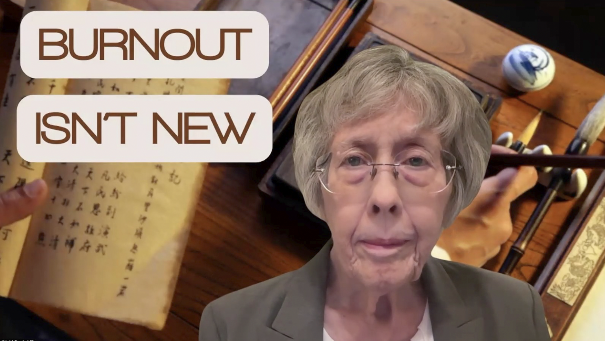
What We Can Learn from 500 Years Ago
We often think of burnout as a modern problem—something caused by a demanding workload with its unsustainable pressure. But actually, people were burning out centuries ago. An article by Jason Wong and Xiao He in The Conversation describes the situation in 16th century China, where state officials faced crushing workloads with periodic performance reviews, just as we have now. (Their government used KPIs (key performance indicators) similar to those in use today.)
What Did Those Burned-Out Officials Do?
The overburdened officials had already realized that their "burnout" was a widely experienced problem and had developed small ways of trying to cope (and to rebel!): sipping tea, immersing themselves in nature, and writing poetry. One, Yuan Hongdao (1568-1610), advocated taking time to be non-productive, such as by taking walks and meditating, to escape from the the oppression of the expectation of constant productivity. Another, Chen Jiru (1558-1639), used "micro-joys" such as sipping tea or burning incense.
Xiaopin
Xiaopin were short, informal, personal essays that focused on everyday life and sometimes served as micro-reflections. They became popular at this time and were another way of taking a time-out from the grind.
From the 1600s to 2025
Even though we live in a very different world––one of the internet and email rather than ink brushes and tea scrolls—the structure of society seems to remain the same. Whether it’s the 16th-century Chinese government or a modern corporation, the systems we live within still impose conditions that lead to burnout. And like those officials centuries ago, many of us struggle to find moments of respite––moments when we belong to ourselves.
Our Inner Guides Can Help
We have tools today that those Chinese officials didn’t. Instead of relying only on micro-moments to temporarily escape the stress, our Inner Guides will provide more definitive solutions to the situations that lead to burnout. If you don't yet have an Inner Guide, I will soon be offering a way for you to acquire one.